

FUTURE DATE
Côte d’Azur Tour
Tour Duration
5-1/2 days cycling
6 nights
Intensity
3.5+/5
options
Performance road e-bike
price
TBD
Trip Highlights
-

Discover the beauty and charm of Nice, Èze, Monaco and Menton, and why so many pro cyclists make their home on the French Riviera.
-

Sustain and build your summer fitness while exploring the elegance of the Côte d’Azur and the rugged terrain in the Alpes Maritimes.
-

Cycle the same amazing roads and climbs that are used in the annual Paris-Nice stage race, including Col de la Madone, Col de Braus and Col de Èze.
-

After a challenging day on your bike, recover in your own, single-occupancy hotel room, one with views of the blue Mediterranean sea and sky.
Professional cyclists competing in Europe tend to gravitate to three regions for their homes-away-from-home: Girona, Spain; Andorra; and the French Riviera or Côte d’Azur, including Monaco. In choosing, they consider cost-of-living, taxes, transportation links, year-round weather, variety of cycling terrain, and community. This tour will demonstrate why so many cyclists are attracted to the Côte d’Azur.

When we ran this tour in October 2025, our participants praised it so highly that we plan to run it again. The French Riviera, known in French as the Côte d'Azur (a nickname given to the region in the 1800s because of its year-round climate with "a sky as blue as its sea”), is the Mediterranean coastline of the southeast corner of France. There is no official boundary, but it is considered to be the coastal area of the Alpes-Maritimes department, extending from Cannes to Menton, which borders Italy. Nice, the fifth largest city in France with a population of 350,000, anchors the region with the third largest airport in the country. The Principality of Monaco, an income-tax free sovereign city-state (the second smallest in the world, after Vatican City), is a semi-enclave within the region, surrounded on three sides by France and fronting the Mediterranean.
The Greeks began establishing settlements here during the 7th century B.C., and later, around the time of Christ, the Romans began building towns, monuments and amphitheaters, many which still survive. A few kilometers from our first Ride Camp hotel, in the village of La Turbie, are the ruins of the Tropaeum Alpium (Trophy of the Alps), a monument built in 7 B.C. to celebrate emperor Augustus' decisive victory over 45 tribes who populated the Alps.
From the fall of the Western Roman Empire in the first half of the 5th century until the late 18th century, the Côte d'Azur was a remote and impoverished region, known mostly for fishing, olive groves and the production of flowers for perfume. But then the British discovered Nice and its warm winter climate, and it quickly developed into a winter health resort for the British upper class. With the arrival of the railway in the mid-19th century, the region became a playground and vacation spot for aristocrats from many nationalities.
The region first started attracting the attention of cyclists when it was included in the 1906 Tour de France (the fourth edition of the race), and the cyclists had to conquer a brutal 214 mile (345 km) Stage 5 through the mountains of the Alpes Maritimes from Genoble to Nice. In 1933 the annual Paris-Nice week-long stage race was started, and it has now become a prominent race in the annual pro cycling calendar. (The event is known as The Race to the Sun, since it runs in the first half of March, typically starting in cold, late-winter conditions in Paris before reaching the spring sunshine on the Côte d'Azur.) Professional cyclists soon realized the region was an ideal place to live, not only for its superb, year-round climate, but also for the wide range of challenging climbs on excellent roads in the Alpes Maritimes that are easily accessible on daily training rides. [When Lance Armstrong lived in Nice during the 1990s he trained on the Col de la Madone climb so often that his sponsor Trek named one of its bicycles after it.] It is also easy to get from Nice to just about anywhere, with its excellent international airport and train connections. While the cost-of-living is higher than Girona, Spain, it is still reasonably affordable. And although it may be one of the more expensive places to live, successful non-French cyclists who wish to shield their income from taxes sometimes find Monaco highly attractive.
We have designed a Côte d’Azur Tour that is intended to show off the best of the French Riviera and the Alpes Maritimes to confident cyclists. We will stay in three different hotels to enable you to experience the best routes in the region without requiring really long days on the bike or van transfers at the beginning or end of each day. Our first hotel in the hills above Èze - where we will stay for three nights - boasts outstanding Mediterranean views from every hotel room, and it is from there we kick off our trip with a short, late-afternoon warm-up ride. A clockwise loop from our hotel will take us to Nice and back on two of the three famous Corniche (balcony) roads between Nice and Menton, ending with the Col d’Èze climb often used as a last stage summit finish in the Paris-Nice race. Day 2 will be a moderate day to help us get over jet lag: the route take us to the Col de la Madone via the rustic village of Gorbio, and ends with a short, beautiful climb to the Monte-Carlo golf club in the hills far above Monaco. Day 3 is a big day, showing off the Col de Braus and, if the riders have the legs, the epic hairpin turns of the Col de Turini, featured in the annual Monte Carlo rally. Day 4 is a transfer day, taking us deep into the Alpes Maritimes and a remote out-and-back 3,000 ft (900 m) climb to the stunning views of the Madone d’Utelle, ending at an excellent cycling hotel in a mountain valley village north of Nice, where we will stay two nights. On Day 5 we ride a loop along stunning mountain roads that takes us through deep gorges to classic medieval villages perched impossibly along imposing cliffs. Much of the route was used in Stage 6 of the 2016 edition of Paris-Nice, and it includes two climbs, one categorized Cat 2, the other Cat 1 (learn more about cycling climb categories here). About 50 miles (80 kms) into our route, when we will have begun the descent back to our hotel, we have the option to add a challenging 7 kilometers of narrow switchbacks up to the spectacular Mont Vial, where on a clear day one can see Cannes, Nice, Monaco and even Corsica. Day 6, our last day on the bike, is one more day in the rugged Alpes Martimes, but more moderate than the prior three days, taking us over the modest Col de Vence to the coast, where we cycle 5 kilometers of boardwalk along the beach to our seafront Nice hotel, arriving mid-afternoon so you can explore this delightful city, home to so many pro cyclists. Day 7 is for departures, with the Nice Côte d’Azur airport a short Uber ride away.
Day-to-Day Itinerary
-
The Ride:
Corniche Loop to Nice with Col de Èze | 28 miles (45 km) | 3,000 ft (925 m) elevationWhat to Expect:
Please plan your travel to arrive at Les Terrasses d’Eze Hôtel by 2:30 PM to meet your guides and check-in. Major U.S. carriers offer non-stop flights from various U.S. cities to Nice, and there are many other options via a connection in Europe. From the Nice airport a taxi (which we encourage because our hotel is not easy to access via public transportation) will take 30 minutes and cost €50-65. We will help you coordinate with other participants arriving at the same time to share a ride.When we meet you at check-in we will hand you our schedule/plan for the rest of the day and a day bag that is yours to keep and use during the week. In the bag will be two water bottles (bidons) with your name on them, a cycling gilet, and a neck gaiter. We will ask you to meet us at 3:30 PM in the courtyard outside the hotel lobby wearing your cycling kit and everything you need to ride, including helmet, water bottles, lights, cycling computer, etc. Also, please bring your computer mount, pedals and saddle (if you are particular about saddles and brought your own) for your bike fitting, which is our first priority. While the rental bikes should have been dialed into the measurements/specifications you will have provided in advance, some minor adjustments are typically needed. Once you are happy with your bike fit, you can stop by the feed/hydration table to prepare your water bottles and grab an energy bar, piece of fruit or snack for your jersey pocket.
After the fitting we will meet on the hotel terrace (with its dreamy views) for a short overview of the week, what to expect in terms of support, our cycling etiquette and safety principles, and a review of today’s warm up ride, which is a loop to Nice and back. We will likely get started from the hotel around 4:30 PM, descending to the seaside Basse Corniche, which is one of the three Corniche (or balcony) roads between Nice and Menton. [Traveling east from Nice one first reaches Èze, then Monaco, then Menton, then the Italian border.] As we cycle west along the coast to Nice, we will ride through the peninsula of Saint-Jean-Cap-Ferrat, one of the “pearls” of the French Riviera and playground rich and famous, the second most expensive residential location in the world, after Monaco. Our route takes us briefly into Nice, and we will cycle past the port, where you will see some of the largest yachts in the world. Facing the port is the Café du Cycliste, once just a coffee shop, now a cycling brand offering far more, including branded apparel, bike rentals, additional stores in Mallorca and at the foot of Mont Ventoux, and sponsoring a professional gravel cycling team. Depending on interest and time (the café closes at 6:00 PM), we may stop for a coffee.
Our return to Èze is via the Grande Corniche, which takes us to the summit of the Col d’Èze, a route almost always included in the last stage of the Paris-Nice race, often as an individual time trial. In 2012 Bradley Wiggins set a record on the route with a time of 19:12. The climb was also included in the 1953 and 2020 editions of the Tour de France, both times designated a Category 2 climb.
We should be back at the hotel by 7:00 PM, and then gather for a welcome dinner at the hotel at 8:00 PM. Over dessert we will review our plan for Wednesday.
Hotel Les Terrasses d’Eze: https://www.hotel-terrasses-deze.com
-
The Ride:
Col de la Madone Loop with Monte Carlo Golf Club | 30 miles (50 km) | 6,000 ft (1,800 m) elevationWhat to Expect:
Since this is your first full day on the Côte d’Azur, and many in our group – if not all – will be a bit jet-lagged, we will start our day an hour later than we will the rest of the week (please see description of a typical day’s schedule in the FAQs), and our optional inspirational morning devotions will begin at 8:30 AM, breakfast at 9:00 AM, and the ride start at 10:00 AM.Not counting yesterday’s late afternoon warm-up ride, today’s ride will be the shortest of the week, designed to introduce you to both the beauty of Côte d’Azur and the amazing roads at the doorstep of the pro cyclists that live here. Instead of turning left out of the hotel and descending like we did yesterday, today we turn right and begin to a modest ascent to the village of La Turbie, where stands the ruins of the Tropaeum Alpium (Trophy of the Alps), a monument built in 7 B.C. to honor the Roman emperor Augustus’ conquest of the 45 tribes inhabiting the Alps. From there we cycle east along the Route de la Turbie, high above Monte Carlo, circumnavigating the Principality of Monaco. Soon after entering the French commune of Rocquebrune-Cap-Martin, we turn inland, heading northwest towards the medieval storybook village of Gorbio, perched 354 meters above the Mediterranean Sea. This picturesque village, which seems to be forgotten by tourists, will immediately charm you. As we enter the traditional village square, the Place de la Rèpublic, you cannot miss the ancient elm tree, planted in 1713, that is celebrated with a town festival every September. As we stop at our support vehicle to refill our water bottles, you will wonder if this is a set for a Disney fairy tale movie, and almost expect to see Belle comes dancing down a cobblestone lane with a basket of library books. More likely you will notice village locals congregating at the café on the square to chat and exchange pleasantries; we may join them.
From Gorbio we enjoy a 5 kilometer descent towards Menton, but instead of heading to the beach, we turn northwest again and begin the climb made famous by Lance Armstrong, the Col de la Madone. This is a climb that presents a predicament to the beauty-loving avid cyclist: to stop and take photos of the amazing views, or to push hard and try to record a good Strava segment time? On the climb you cannot help but notice the village of Sainte-Agnès that we will cycle past, impossibly perched at 800 meters above the sea. You will have no doubt why it was included on the list of Les Plus Beaux Villages de France (The Most Beautiful Villages of France) in 1997.
The 10.5 kilometer Col de la Madone is a good representation of the types of climbs that we will encounter on this Ride Camp, perhaps somewhat harder than most, with an average grade of 6.9% and the steepest one kilometer section at 8.1%. Our support vehicles will be waiting for us at the top of the climb, and if the weather is pleasant, that is where we will enjoy a picnic lunch. From the top of the Col we have our first big descent of the week, 10 kilometers long, with the first 4 kilometers very fast. The road is good, but beware of oncoming cars, keep your eyes on the road and not the views, and don’t overcook the occasional tight turns! As we enter the village of La Turbie, be prepared to make a hard left turn for a special treat: the little known climb to the Monte Carlo Golf Club. Only 4 kilometers long, the climb has a steeper average grade than the Col de la Madone (7.3% vs 6.9%), but it offers amazing views of Monaco and the Côte d’Azur. Unfortunately none of your guides are members of the club, so instead of stopping at the clubhouse for a cold drink, we will briefly admire the greens and then to turn around to descend to La Turbie and our hotel.
We should arrive back at the hotel by 2:30/3:00 PM, and after dropping your bikes at the storage room, you will be treated to our daily post-ride feed table. The next few hours are free to use as you please, perhaps going for a swim in the hotel’s infinity pool, visiting the spa, playing some tennis, or simply relaxing on your hotel room terrace with a cold drink. At 6:00 PM we will meet to drive the 2 kilometers to the village of Èze, where we will have dinner. Dinner will be at 7:00 PM, but you will have 45 minutes to explore this incredible village, which has been described as an "eagle's nest", and one of sixteen villages on the Côte d'Azur Route des Villages Perchés (Route of Perched Villages) - we will cycle through others in the coming days. Built around 1400, Èze clings to the mountainside 427 meters above the Mediterranean Sea. Panoramic views; narrow, cobblestone alleys adorned with vibrant flowers; ancient façades; and an unbelievable attention to detail, are some of the features of this ancient village. As you wander around before dinner, taking in the architecture and absorbing the views, you cannot help but be enchanted.
Over dessert we will review what to expect on Thursday, which will be a much bigger day on the bike than the one we enjoyed today.
Hotel Les Terrasses d’Eze: https://www.hotel-terrasses-deze.com
-
The Ride:
Col de Castillon and Col de Braus | 60 miles (95 km) | 8,500 ft (2,500 m) elevationAlternate Ride Option:
Col de Braus and Col de Turini | 80 miles (130 km) | 11,800 ft (3,500 m)What to Expect:
Today will be our biggest climbing day of the week, with three named Cols to summit as we cycle a counter-clockwise loop from the hotel. [The night before we will review with the group the option to cycle an alternate, similar but longer and more challenging, route that adds the epic Turini, but we will only tackle that if there is a group consensus after Day 2.] Like Day 1 we will descend to the coast, but instead of cycling east toward Nice, we will head west past Monaco, riding just outside the Principality’s border on an avenue named after the Prince who famously married the actress Grace Kelly and ruled the city-state until 2005. Our route takes us through Roquebrune-Cap-Martin like we did yesterday, but this time much closer to the coast, and we will ride through the posh Cap Martin peninsula and the modern seaside resort of Carnolès, with its long pebble beach bordering Menton. After another kilometer of riding along the Menton beachfront, we turn inland and begin the 14 kilometer climb to the Col de Castillon. The climb averages 4.9% and rarely stresses the legs, with the steepest one kilometer section only averaging 6.9%. After the mid-point we will start to encounter some switchbacks, and if the day is clear, some of the turns that loop back towards the coast may merit a stop to take in the views. Our support vans will be waiting for us at the top of the climb, where we can access layers for the sweeping 7 kilometer descent to the town of Sospel, where we will enjoy a feed stop. The town dates back to the 5th century, when it served as an important staging post on the royal road from Nice to Turin. As we cycle through Sospel you may notice an ancient toll bridge crossing the river that divides the town, which dates to the 13th century. The bridge was bombed by the Germans during World War II to prevent contact between the French Resistance and the Italians.From Sospel we begin the second climb of the day, to the Col de Braus, 11.5 kilometers long at a 5.7% average grade. Be prepared for some steep ramps on the climb - some over 9% - and a challenging one kilometer section that averages an 8.3% grade. At the top of the climb we will stop for lunch, either a picnic or a restaurant lunch at the cyclist friendly Buvette Col de Braus. From there we have a 17 kilometer descent to enjoy, the first portion on the hairpin turns of the western side of the Col, the last portion in a gorge that parallels a river. About halfway down the descent we will cycle through the town of L’Escarène, where if one has not slowed down and kept an eye on the GPS route, it is very easy to miss a key turn. The descent ends in the town of Le Grave de Peille, and we immediately begin our last climb of the day, roughly 8 kilometers to the Col de Saint-Pancrace. As we approach the village of Peille (another village implausibly perched on a rock on the side of a mountain), which dates to the 13 century, don’t be surprised when the climb ramps up steeply. The first 2 kilometers as we leave the town is a spectacular, mostly level, balcony road, and then the descent to La Turbie and our hotel begins, much of it familiar from the latter half of yesterday’s descent from the Col de la Madone.
We should arrive back at the hotel by 4:00 PM. Dinner will be at 7:00 PM at the hotel, and over dessert we will discuss our plans for Friday, which will be a transfer day.
Hotel Les Terrasses d’Eze: https://www.hotel-terrasses-deze.com
-
The Ride:
Madone d’Utelle | 65 miles (105 km) | 8,000 ft (2,400 m) elevationWhat to Expect:
Today is a transfer day, which means we will need to say our good-byes to the amazing hotel where we have spent the last three nights and breakfasted on a terrace with spectacular views of the rugged Mediterranean coastline. After dropping our luggage at the vans and preparing our water bottles, we start our ride by descending towards Nice on the Moyenne Corniche road, which is the last of the three balcony roads we will have not yet cycled. On the way towards Nice we will pass the village of Èze, where we had dinner on Day 2, and a few kilometers before arriving the city we will take a sharp right and warm up on a steep, 2 kilometer scenic climb that takes us to the Grande Corniche, which we ascended to the Col d’Èze on Day 1. We continue descending toward Nice, then work out way through the city and north for 30 kilometers toward the mountain that will define our day, the Madone d’Utelle, a favorite training climb for local pros. The ride through the backcountry to get there is special, some of it a spectacular balcony road, and before arriving the summit we will have passed three more villages on the Côte d'Azur Route des Villages Perchés (Route of Perched Villages), one in which we will enjoy a coffee/pastry stop at a classic French village café.The Madone d’Utelle climb is 10 miles (16 kilometers) long, ascending 3,000 feet (900 m) at a steady average grade of 5.5%. Because it is remote, and not a pass, it has not often been used in races, but in 2016 it hosted a summit finish on Stage 6 of Paris-Nice, classified as a Category 1 climb. [We will cycle other portions of that stage on tomorrow’s route.] At the summit we will find not only spectacular views, but also a sanctuary. Legend has it that over a thousand years ago Spanish sailors caught in a tempest on the Mediterranean Sea made a vow to build a chapel to the Virgin Mary if their lives were spared. Their prayers were answered when a blinding light illuminated a mountain in the distance, and the Virgin appeared in the sky. The sea quieted and the sailors were spared. They kept their vow and built the chapel. In 1800 the French fought Italian and Spanish forces for control of this region, and in the process the chapel was destroyed, but rebuilt in 1806. On our ride to the summit we will pass the perched village of Utelle, which dates to Roman times. If the weather is warm and the wind modest, we may have a picnic lunch at the top, but more likely we will don layers and descend to Utelle for a restaurant lunch in the village.
Once at the base of the climb we will enjoy a mostly-flat-to-gently-downhill 25 kilometers of cycling, best ridden in a pace line, to our excellent hotel in Carros, another of the perched villages. We should arrive by 4:30 PM, with time for rest and recovery after a stop at the post-ride table. Riders might want to consider a swim in the attractive hotel pool, before we meet for dinner at the hotel at 7:00 PM.
Lou Castelet Hotel: https://loucastelet.com/?lang=en
-
The Ride:
Gilette Loop with Mont Vial Option | 70 miles (110 km) | 7,200 ft (2,125 m) elevationMont Vial Option: +10 miles (15 km) | +2,000 ft (575 m)
What to Expect:
Today’s ride is an awe-inspiring clockwise loop into the rugged Alpes-Maritimes, following a portion of the route used in Stage 6 of the 2016 edition of Paris-Nice. Slightly longer than yesterday’s route, it passes numerous medieval villages - starting with the charming Gilette and ending with the equally enchanting Bonson - and features two moderate climbs, the first classified a Cat 2, the second a harder Cat 1, that together equal the total of the Madone d’Utelle that we will have cycled the prior day. Throughout our ride we will enjoy stretches of balcony roads, with steep drops on one side and stunning views of the valley below and the mountains across from us. As we start our descent we have the option to tag on one last epic climb, 7 kilometers of steep switchbacks on a narrow road to Mont Vial, 350 m higher than the Madone, but with an antenna at the top instead of a sanctuary. Unless the weather is terrible, we will strongly encourage the group to try this climb. On a clear day the views are truly spectacular, and one can see the Col de Turini to the east, Cannes, Nice and Monaco the the south. and sometimes even the dark profile of Corsica on the horizon. As we continue our descent, we will cycle past the village of Revest-les-Roches, where you may notice a massive oak tree, 800 years old, that has stood impassively as generations have passed by. After 8 kilometers of descending from Bonson we will reach the modern roadway, and end the day with 10 kilometers of cycle path to our hotel in Carros.After a few hours of rest and recovery, we will meet for one last dinner in the hotel, and discuss plans for our last transfer - this one to Nice - in the morning.
Lou Castelet Hotel: https://loucastelet.com/?lang=en
-
The Ride:
Col de Vence to Nice | 45 miles (75 km) | 4,000 ft (1,200 m) elevationWhat to Expect:
After three consecutive big days on the bike, today’s route is far more moderate, and most will consider it the second easiest route of the week. Perfect for a Sunday ride, particularly following an inspirational morning devotion led by our trip chaplain, Marc Porpilia. While the route is beautiful, starting with more of the rugged alps, and ending with 5 kilometers of riding along the Nice seafront, it only covers 45 miles (75 kilometers), with no major climbs on the day. Our goal in designing this route was to arrive our Nice hotel by early afternoon, giving you the chance to explore the city that anchors the French Riviera.After dropping our luggage at the support vans and preparing our water bottles, we cycle north from the hotel like we did yesterday, but soon turn west, cycling past more medieval villages. After 30 kilometers of ascent at a moderate 4% grade we will reach the highest elevation of the day, the charming village of Coursegoules, where we cycle narrow, cobble streets to a classic French café for lunch.
After lunch we will head south, gently descending to the Col de Vence, which is a popular climb most often cycled from the opposite, classic side, which we will descend. The 10 kilometer descent from the Col is fast, the grade averaging nearly 7%. After regrouping in the village of Vence at the bottom of the descent, we will have another 10 kilometers of flat riding, then 4 more kilometers of descending, finally reaching the roads that take us into the western neighborhoods of Nice, past the airport and to the bike path along the coast. Our cycling ends with five kilometers of leisurely riding along the beachfront boardwalk (watch out for pedestrians!) until we reach our seafront hotel.
Parking is very limited in Nice, and our vans will be parked in a temporary loading zone next to the hotel. Upon arriving you will need to drop your bike with our support team, taking off everything that is yours before heading to the post-ride table and your hotel room. Don’t forget to take your day bag, and anything else that you may have left in the vans, because you won’t see them again, with most participants taking an Uber to the airport in the morning.
The rest of the afternoon is free for you to explore Nice. We will plan to meet at 7:00 PM at a nearby restaurant for a final celebratory dinner together, toasting our amazing week of cycling on the Côte d’Azur.
Mercure Nice Marché Aux Fleurs Hotel: https://mercurenicemarcheauxfleurs.com-hotel.com/en/
-
Sadly, our Côte d’Azur Tour will have come to an end, and we will need to wish one another Godspeed. Since many of the group will be leaving the hotel early and taking taxis or Ubers to the Nice airport for morning flights back to the U.S., we will not gather for morning devotions. Nevertheless, for those whose schedule permits, the hotel breakfast buffet will be available starting at 7:30 AM. Of course, if you wish to extend your stay in Nice and the Côte d’Azur longer, you are welcome to do so.
Weather
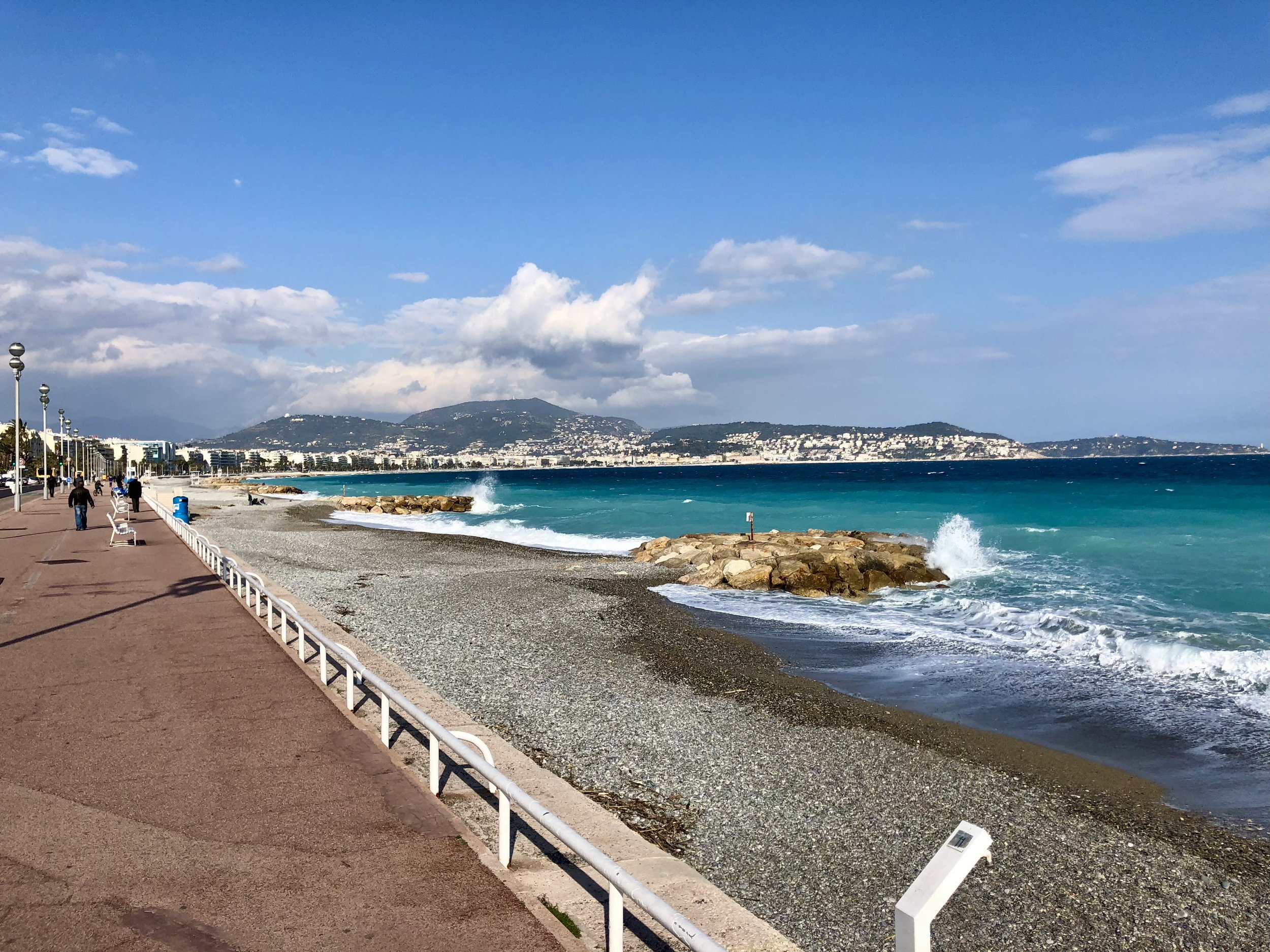
Late Spring and early Fall are considered the best time to visit the Côte d’Azur, with ideal weather for cycling. Expect temperatures at the start of our daily rides around 60º F (16º C), warming to the low 70ºs F (22-24º C) by early afternoon, with cooler temps at mountain summits. Overnight lows will be in the mid-to-high 50ºs F (13-15º C). Rain can be expected once or twice during the week, often light and lasting only part of the day. We will provide a detailed recommended packing checklist to registered participants.
FAQ’s
-
6 nights accommodation in a single occupancy room at three different hotels
6 breakfasts
5 lunches (some mid-ride picnic lunches, others at a restaurant)
6 dinners, which will include local wines and beer
Carbon road bike rental with 2×12 electronic shifting
5.5 days guided rides with two support vehicles and an experienced mechanic
Daily GPS routes for your cycling computer
Pre-ride, mid-ride, and post-ride feed tables, including hydration mix/tablets, fruit, snacks, gels, etc.
Two new bidons (water bottles) that are yours to keep
A personalized day bag (for storing extra kit in the support vehicle) that is yours to keep
A mesh wash bag for your kit (helpful if you use the hotel laundry) that is yours to keep
A Rivendell Cycling wind gilet/vest that is yours to keep
-
Airfare
Transfers to/from the hotel
Lunch on the day of arrival
Lodging before and/or after the trip
Personal items purchased during the trip
Personal hotel charges (spa, laundry, snacks, drinks, minibar, etc.)
Alcoholic drinks, other than the local wines and beer included at dinner
Trip insurance (which we require all participants to purchase)
Gratuities for our support team. For this trip, if you are pleased with their support, we recommend a gratuity of €100-200 for the team.
-
$300 for an upgrade to a performance road e-bike
If, after reviewing the daily ride schedule, you are concerned about the distances or elevations involved, or your ability to keep up with the group, we encourage you to book a performance road e-bike. These bikes look, ride, and handle like drop-handlebar road bikes, except they are heavier and have power-assist on demand.
-
We will be staying at three different hotels during this Tour.
On most days of the Tour, the daily program will look like something like this:
7:30 AM:
Optional meet-up at a designated place in the hotel for an inspirational morning devotional based on a scripture passage from the Bible, led by Marc Porpilia, a sports chaplain who is gifted in inspiring, encouraging and challenging athletes (see bio on About page).7:45 AM:
Breakfast in the hotel’s dining room. At our first hotel in Èze, you will have the opportunity to dine on an outdoor terrance overlooking the Mediterranean coast.8:10 AM:
Return to your hotel room to don the day’s cycling kit and collect day bags, bidons, helmet, gloves, sunglasses, bike computer, lights, etc.8:30 AM:
Visit the pre-ride table we will have set up to fill water bottles/add electrolytes and grab snacks/energy bars/gels/fruit for jersey pockets. Then meet at the bikes and drop day bags at the support vehicle. On transfer days you will also need to bring down your luggage.8:45 AM:
Ride begins. Our two support vehicles will be available throughout the day, particularly at the top and bottom of climbs, for you to access layers/gloves from your day bags for descents or rain, or to remove layers when you are too warm. Feed stops will be provided at strategic times during the day.Midday:
We will stop for either a picnic or restaurant lunch.4:00 PM:
Our rides will typically conclude by this time at the hotel, often earlier.4:00-7:00 PM:
Free time to rest/recover. Our first two hotels, where we are staying a combined 5 nights, offer beautiful swimming pools, the first an infinity pool overlooking the coast. The first hotel also offers a world-class spa and 2 outdoor synthetic grass tennis courts.7:00 PM:
We meet for dinner, typically in the hotel, but on one night in Èze we will ride in our support vehicles to a nearby village restaurant for dinner. On our last night in Nice we will walk to dinner. Over dessert we will review the next day’s ride. Typical topics will include a review of the route, the elevation profiles of the major climbs, when/where to expect feed stops and lunch, a summary of the weather forecast, and tips on what to pack in your day bag, which you can access from the support van throughout the ride.9:00/9:30 PM:
Our goal is to enable riders to be back in their hotel rooms no later than 9:30 PM, so that they can maximize their sleep time. Sleep is key to recovery, and strong recoveries are necessary to sustain the six consecutive, often-challenging, cycling days we have planned. -
This Côte d’Azur Tour has been rated a 3.5+/5 intensity. which means you can expect to cycle 40-70 miles (65-110 km) per day, with 3,000 to 8,000 feet (900-2,400 mts) of elevation. [The + means that on some days you will have the opportunity to challenge yourself to an even bigger ride.] Most of the avg grades on the climbs we will cycle are considered moderate, in the 5.5%-7% range, and only one climb has a 5 km section at 8%. There will be a few punchy ramps with steeper grades, but they will not be long.
We encourage riders to have a power-to-weight ratio of 2.8 or higher for this tour, or to choose the performance e-bike option. If you consider yourself an active cyclist, but you have concerns about your ability to (i) keep up with the group, (ii) make it up the climbs, and (iii) last the entire day and still be able to do it again the next day, then we strongly encourage the performance road e-bike option. If you have any questions about your fitness level for this tour, or whether or not you should request a performance road e-bike, please contact us.